The Council of the Jinn-Saints: Inside the otherworldly charm of Firoz Shah Kotla
If you search for ‘Firoz Shah Kotla Fort’ on Google Maps, the pin will navigate you across Delhi’s terrains to this location. And just as you virtually arrive at the destination, you will find right below the monument’s name a subheading: Supposedly haunted fortress ruins. This haunted story of Firoz Shah Kotla features very prominently in the history-circles of Delhi. Even if you look up heritage walks that are led here, either the titles would have the words ‘haunted’ or ‘jinn’ in them or the descriptors would give details about the mystique of this site, and why it is exactly that which should interest a potential visitor.
What is clear is that the allure of this fortress lies in its haunting. It draws you in precisely because of its otherworld. But in the case of Firoz Shah Kotla, the treatment of the word ‘haunted’ is different since there is actually neither mystery nor fear. The stories are very clear about what happens here: we know exactly who ‘haunts’, or rather, ‘inhabits’ this monument. Not only are we aware of their nature, but particulars are taken care of, there are names of the jinn, from Lath Wale Baba to Nanhe Miyan.
What is clear is that the allure of this fortress lies in its haunting. It draws you in precisely because of its otherworld. But in the case of Firoz Shah Kotla, the treatment of the word ‘haunted’ is different since there is actually neither mystery nor fear. The stories are very clear about what happens here: we know exactly who ‘haunts’, or rather, ‘inhabits’ this monument. Not only are we aware of their nature, but particulars are taken care of, there are names of the jinn, from Lath Wale Baba to Nanhe Miyan.
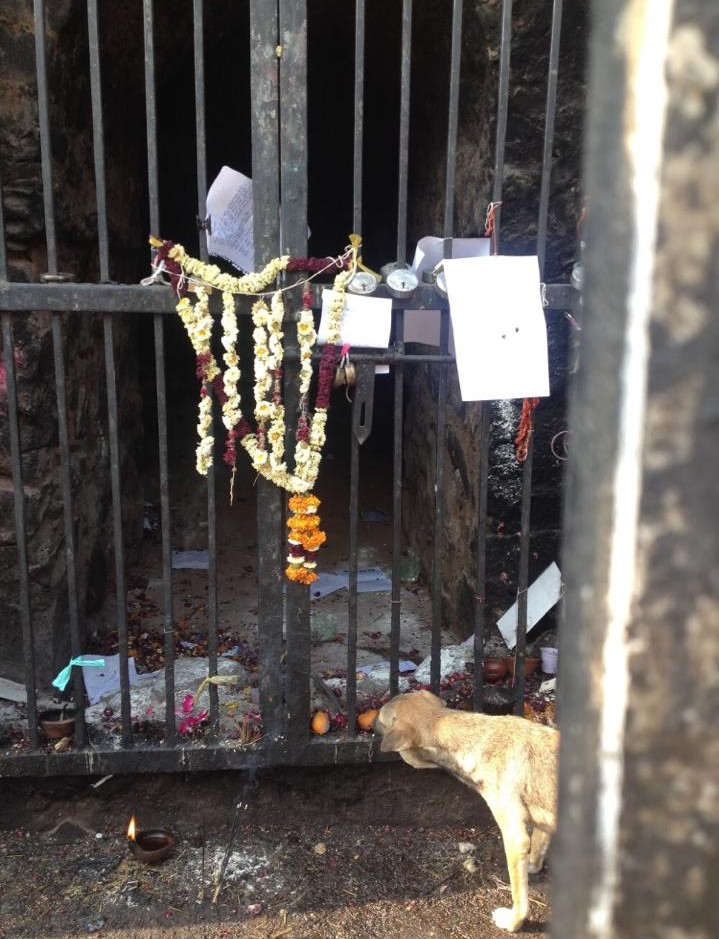
It should be clear from our previous chapter on Jamali- Kamali that the jinn are as complicated as humans and have the will to choose the path they wish to lead. In the case of Firoz Shah Kotla, the jinn are saints, and the practices that are followed here are akin to what one sees in Sufi shrines: from the arziyans (applications/letters) that are presented here to the referring to the jinn as baba. This is why Qismat Ali took the name of Firoz Shah Kotla in the same breath as he spoke about the other prominent dargahs of Delhi. When I talked to one of Delhi’s most beloved historians, Sohail Hashmi, he said that for the first time at Firoz Shah Kotla, he had seen people going as supplicants to the jinn: ‘Normally, this happens between people and a Sufi. You go to the shrine of a Sufi and make a vow. The Sufi is beholden to you; you tie a thread, you put a lock on one of the grills. If your wish is fulfilled, you release the Sufi, you undo this knot. People exercise this ritual at Firoz Shah Kotla; there are locks and holy threads. I haven’t seen this at other places!’
Though there is this spiritual intimacy, what you also see here is a highly bureaucratic procedure for approaching the jinn. In the many niches of Firoz Shah Kotla, one could often spot passport-sized photographs and photocopies of government-approved ID cards placed with the hope that once their pleas are submitted and the jinn come across their files, they will know exactly whose grievances they are addressing. There is the Darbar-e-Jinn, the Court of the Jinn, that takes place once the monument empties out and its gates are locked. It is then that the jinn go through the petitions and find solutions. Once a devotee has put their faith in the jinn of Firoz Shah Kotla and believe that it was through their miraculous intervention that their lives have become easier, they return to the monument frequently, even inviting the jinn to celebrations, such as marriages and dawats (feasts).
However, these administrative formalities are not confined to the relationship between the jinn and the devotees. The wider bureaucratic system has also influenced the practices and relationships people forge with the monument. Protected by the Archaeological Survey of India, as of 2025, there is a ticket that costs Rs 25 for Indian citizens, but the fee has been an issue, even covered by the press. A 2022 Hindustan Times article records a stir on Eid when devotees were asked to pay to enter, with a mention that there was a time when fee was waived off on festivities and other articles talk about how it would not be taken on Thursdays.
With regards to access too, once inside, there are certain parts of the monument that are accessible for worship, while some, like the pyramid of the pillar and the ten odd archways on the front side of the chambers, are no-gos. One wonders when and between whom these arrangements of access were made, but they exist. Between my own visit to the site discussed in the previous section and my subsequent travel there in August 2025, the site had transformed even more. Security was tighter than ever. On a Thursday afternoon, I stood in a long line for a check in at the gate where even my small handbag had to be opened. The guards explained they were checking for flowers and candles—anything that could be offered to the jinn-saints.
Inside, the difference was clear. The crowds were very thin. Partly because of ticket prices, partly because visitors could no longer bring offerings. At the alcove of Nanhe Miyan, a small family stood before the recessed arch in the wall, some bowing their heads against it. One woman sat on the ground, forehead pressed to the stone, praying. All that one could do now was stick coins on the wall; there was not a letter in sight. At the Ashokan pillar, or Lath Wale Baba, a circle of devotees moved around the pyramidal enclosure. Unable to tie knots or threads, they gripped the metal rods with fierce intensity. Many cried out for the baba, voicing grievances and pleas that once would have been folded into papers.
At the archways under the mosque, some still managed to sneak in tiny threads, and some little pieces of paper, but a lone security guard shadowed them. He didn’t stop anyone from placing offerings but simply waited till they were done so that he could retrieve them. He picked them all up and carried them away, and kept doing this for hours on end. When I caught him on a break, standing with a few licensed tour guides, I asked how long it had been so strict. He said they’d been phasing out these practices since last year, not just the offerings, but also the ‘clandestine lovers’ who found their escape at Firoz Shah Kotla. Then, he gestured theatrically: ‘Look, how clean everything is!’
As I circled behind the pyramidal structure, I came across four generations of women seated together. The eldest—coming here for twenty-four years—shouted at others to leave if they weren’t there to pray. She blamed idlers and ruffians for the bans on offerings. She told me all they needed was a rose and a chaddar, but even without them, if you believed, your grievances would be resolved. Her voice broke as she spoke. Then she closed her eyes and moved her head in a trance, murmuring: ‘Kisi ko farak nahi padtha, kisi ko farakh nahi padtha—Nobody cares, nobody cares…’ Nearby, a boy with his mother kept asking why the ‘cave’ had been closed. She repeatedly said she did not know. He’d never been inside but had grown up on family stories of entering the archways. ‘What’s in there?’ he asked. ‘The baba lives inside,’ she said.
Excerpted from Ghosted: Delhi’s Haunted Monuments by Eric Chopra.
https://speakingtigerbooks.com/product/ghosted/