Life in the Tea Garden: The Many Dangers faced by a Woman Plantation Worker
It had drizzled the night before. The weather was often like this here in the foothills—sunny in the daytime, rainy at night. However, water did not clog the land. Even after a sharp shower during the day, the soil did not become muddy. The earth sucked in the water immediately. The clever white sahibs had found the best land for tea plantations. Due to its suitability, Atharighat had been established, even though it was in the midst of nearly impenetrable jungles.
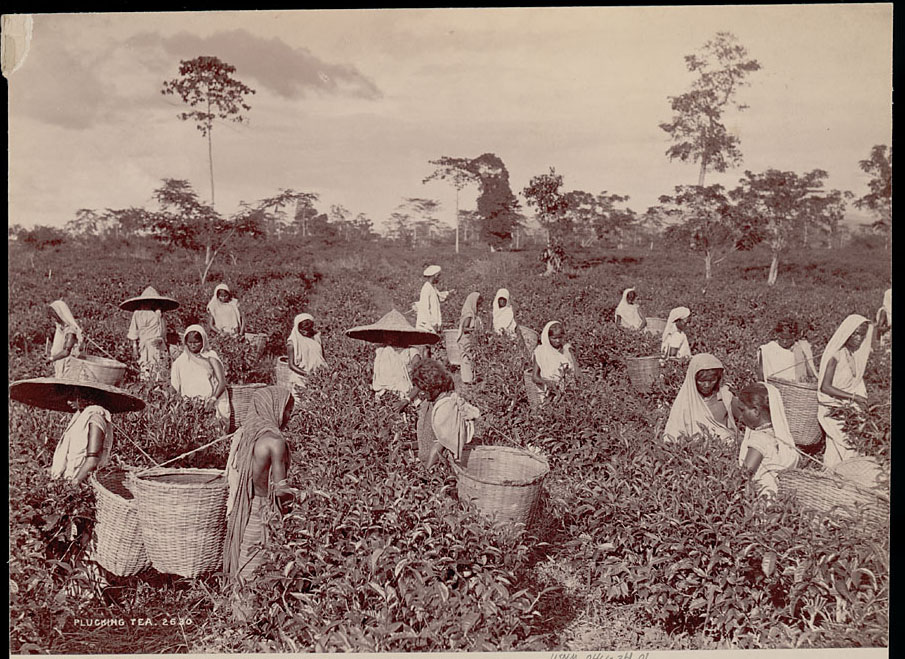
Durgi was picking the two leaves and bud at a fast pace. It was her first day at this job. Earlier she had worked in the newly opened patch of land. She was wearing the toe ring and anklets that rang jhoon…jhoon…jhoon to keep the snakes at bay. Like the other women she chewed betel nut and tobacco leaves. Even the fattest leech would drop to the ground if one spit the saliva of this mixture on it. With the fresh showers, the leeches arrived in hordes. Since no chemical fertilisers were used, they proliferated. They did not pose any problem with the tea bushes, so the administration did not bother to do anything about them and the mazdoors had learnt to deal with them. On every haat day, they bought rolls of raw tobacco leaves that damaged their teeth and caused gashes on their tongues. But that was their problem, the administration did not care.
March to November was the best season to pick tea leaves. In winter it was dry, and the quality of the tea picked then was not good. Atharighat had earned a name for its high-quality tea during Jonathan sahib’s time. Assam tea was different in colour and strength from the traditional Darjeeling green tea. The new shoots here were dried along with the stems, then roasted and packed. When it was added to boiling water the two leaves and bud opened and the colour of the water became like that of orange peels. After boiling it for a minute or so, it had to be taken off the fire and kept covered. When poured out, the liquid gave off a nice aroma. On a holiday in England once, Jonathan sahib had presented a packet of this tea to the Queen. A golden framed photo of young Jonathan in a three-piece suit presenting the packet of Assam Tea to the Queen with her crown and strings of pearls still hung on the wall of the bungalow’s drawing room.
Durgi could not chew dry tobacco leaves like the other women. Once or twice, she did try, but her head had started to spin. Instead, she mixed the tobacco in a bottle of water. So, her teeth were not red like those of the other women; they were sparkling white and shone when she smiled. It was easy to find Durgi, whichever corner of the garden she was in—one just had to follow the sounds of laugher and teasing. She was the first one to start giggling and singing.
That day, her friends asked her to sing a song—‘Durgi ekta gaan gawa.’
‘Ekhon nai hoi, maiki mohori gair deto,’ Durgi replied, saying that the maiki mohori in charge of the women would get angry if she started singing now.
‘Durgike keno ka kohoto, hansi deikhke, mukra deikhke thohor jato’—Who says anything to Durgi? Her smile, her face, make people stop, the women teased her.
Suddenly, the banter stopped. They had spotted the crimson-faced sahib coming their way on his black horse. He stopped where Durgi and her friends were working. Perryton could not resist seeking Durgi out; he was intensely attracted to her. He was just waiting for an opportunity. He had heard from his sources that Dosaru’s arrows had magical power. He could kill a deer simply by following the sound of its hooves; he could bring down a duck mid-flight. Perryton had also seen the way his strong, slim body moved quickly. A man like him would not miss his target, he was sure.
Perryton called the maiki mohori and asked him to tell the women that they must put up a nice dance performance for the new burra sahib who was to arrive soon.
‘Nach gana korboi, baksheesh lagi,’ Durgi was quick to reply. Of course, they would sing and dance, but they expected a reward. The women, ever ready to break into laughter, giggled. Perryton threw a few coins at Durgi. Durgi bent down to pick up the coins from underneath the bushes. Perryton muttered to himself—what a cleavage! He was used to devouring women’s bodies like meat at lunch and dinner, but he had never seen such an enticing pair of breasts. He bit his lips in frustration and left the place at a slow pace.
The women earned only four rupees a month. They quickly and happily picked up the coins Perryton had thrown at them and excitedly decided that they would buy colourful tassels at the haat to tie their hair. The blue-and-red threaded braids would look lovely on their hair as they danced. A Bengali shopkeeper had brought them recently and they had all been eyeing them longingly for some time. But, the money the red-faced sahib had thrown at them was not enough to buy tassels for all of them; they needed some extra money. So, they got down to work extra hard.
The women had picked the tea leaves on the periphery and had entered the interior rows of tea bushes. Four leeches attacked Durgi’s feet. She poured the tobacco-water to get rid of them. She could not afford to spend time worrying over it. There were many things she still needed to buy. Her wage depended on how many tea leaves she picked. Thankfully, she and Dosaru were not caught in the cycle of loans and repayment. Many others, after paying high interest for their loans, buying opium and liquor, were left with hardly anything to buy a sari or a dhoti. A brass plate, a wok, a vessel, a few glass bangles, a pair of earrings—these were things they dreamed of buying. They had to wait patiently until they got their bonus. In the month of Ahin, in autumn, when Durga puja was celebrated, they got their annual bonus. Then the dhak would come alive with its beats, women would wear saris with red borders and adorn their hair with marigold flowers. Ah, when would Ahin come? They who had come to this land chasing a dream, were now used to dreaming.
Excerpted from Moonlight Saga by Arupa Patangia Kalita; translated by Ranjita Biswas