Colonial Rule and Dalits: How the British Raj created Caste as we know it Today
Before the 15th century, no European power had significantly penetrated India. But the global spice trade changed that. The Portuguese, Dutch, Danes, and French came and went—but it was the British East India Company that steadily expanded its hold over the subcontinent.
Initially, British rule was not transformative. Focused on revenue extraction and control, the British leaned on existing social and religious structures, especially Hindu and Islamic legal codes, both steeped in caste. Rather than dismantling caste, they reinforced it—relying on upper-caste landlords for tax collection, thereby deepening caste-based inequalities. As Bernard Cohn notes, the Company’s so-called “non-interference” often meant tacit support for dominant castes that helped maintain order.
By the early 19th century, a reformist spirit emerged, shaped by Enlightenment thinkers and pushed by both Indian reformers like Raja Rammohan Roy and Christian missionaries. Under Governor-General William Bentinck, practices like sati, thuggee, and female infanticide were abolished. Bentinck outlawed sati in 1829, justifying it through utilitarian moral reasoning. Reforms such as the Hindu Widows’ Remarriage Act of 1856 were framed as moral progress but also served colonial interests: bolstering British legitimacy among reformist elites and missionary lobbies.
These intrusions into religious and social customs, however, provoked backlash. Replacing Persian and Sanskrit with English, introducing missionaries, and mixing castes in the army—especially deploying Dalits alongside high castes—violated ritual boundaries. The infamous greased-cartridge episode symbolized these transgressions. These disruptions culminated in the 1857 revolt, which united disaffected elites. After the revolt, the British crown took direct control of India. Queen Victoria issued 1858 Proclamation that promised non-interference in religious and social customs.
The colonial state overtly concerned to control India, went on measuring every possible thing of her with a dictum, “you cannot control what you do not measure.” They adopted national census from 1871 and began counting caste from 1881. The British sought to fit India’s countless jatis into the Brahminical fourfold varna system, distorting their relational local identities. As Arjun Appadurai argues, this classificatory impulse didn’t just describe caste—it produced it as a rigid, bureaucratized identity. The census also fostered competition among castes for higher rank, solidifying boundaries that were previously contextual and fluid.
Legal codification reinforced this. The Indian Penal Code (1860) and the Indian Evidence Act (1872) enshrined caste-based personal laws into colonial jurisprudence. Caste also reshaped the military. After 1857, the British excluded Brahmins and Muslims from rebel regions and privileged “martial races” like Sikhs and Gurkhas—while categorizing Dalits as non-martial, effectively barring their recruitment.
By the late 19th century, Dalits were officially labelled “Depressed Classes.” Ethnographers like Herbert Risley promoted racial theories linking caste to physical attributes, feeding into colonial governance. As Nicholas Dirks notes, caste became central to statecraft—reimagined from a local social code into a tool of colonial rule.
This recognition was a double-edged sword. It gave visibility to oppressed groups but also hardened caste lines, locking identities into state-administered categories—a logic that the postcolonial state would inherit through the constitutional recognition of Scheduled Castes.
Thus, British rule did not create caste, as some Hindutva propagandists insinuate, but it decisively transformed it—fixing what was once a dynamic, localized system into a rigid, institutionalized hierarchy. This colonial legacy continues to reverberate in India’s social and political life.
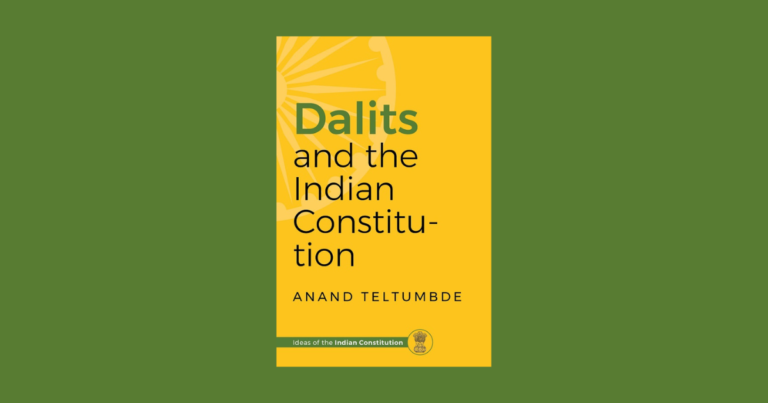
Excerpted from Dalits and the Indian Constitution by Anand Teltumbde