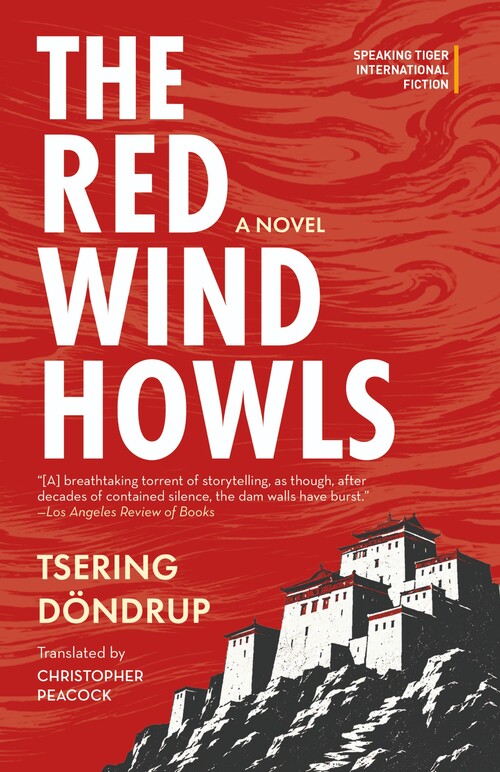
‘Part Gulag Archipelago, part One Hundred Years of Solitude, The Red Wind Howls…[is an] urgent, tragic, and vital testimony for the Tibetan people.’—Woeser, author of Forbidden Memory: Tibet During the Cultural Revolution
‘This is Tsering D?ndrup’s boldest and most meticulously researched novel yet. Capturing the complex and tragic existence of Tibet under Chinese occupation, the book is as much about human suffering as it is about moral courage and the survival of a civilization.’—Tricycle
When the Chinese Communist Party first arrives in Tsezhung in the 1950s, the young reincarnate lama Alak Drong has never heard of the People’s Republic of China. He tells the Party cadre Wang Aiguo that Tsezhung contains heaven and earth, that China is like a tiny line on his palm. Soon that tiny line has swallowed everything.
After Tibetan resistance in Amdo is crushed on the day remembered only as the Harrowing Day, the surviving men are rounded up and taken to labor camps. Alak Drong—once revered and answerable to no one—is beaten, starved and taught that survival requires confession, denunciation and betrayal. Disciple turns on lama, lama on disciple, brother on brother, neighbor on neighbor.
Outside the camps, monasteries are emptied, scriptures burned or made into shoe soles, and children trained to hate and torment ‘class enemies.’ Collectivization overturns the traditional economy, and thousands of young Chinese recruits plough the high-altitude Tibetan pastures, where the crops yield nothing. The harvest fails, the grasslands are ruined and famine follows. All the while, people who do not understand words such as ‘exploitation’ must confess to crimes described in a political language brought from somewhere else, and forced to revere Mao, Marx and Lenin instead of the Buddha.
Unsparing about both Communist rule and Tibet’s own religious establishment, The Red Wind Howls is a darkly funny tale of how a people were made to destroy their faith, their loyalties and the land that sustained them—and call it liberation.
No publisher in China dared touch this novel when it was written. Self-published by Tsering D?ndrup in 2006, copies were subsequently confiscated by the authorities, which suppressed the book and subjected the author to reprisals that have never fully ended.