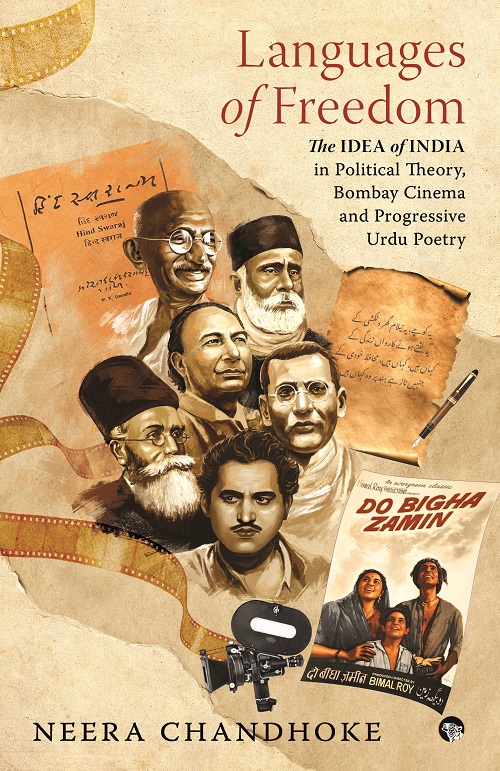
Languages of Freedom asks a simple but urgent question: what does it mean to be free—and why does freedom so often slip through our hands?
In these wide-ranging and incisive essays, political scientist Neera Chandhoke moves between political theory, mid-20th-century Hindi cinema and Urdu poetry of the Progressive Writers’ Movement to trace how freedom has been imagined, claimed and constrained in modern India.
Beginning with early conceptions of freedom—from 19th-century revivalists to the idea of swaraj as articulated by Dadabhai Naoroji and transformed by Gandhi—she examines how ‘Indian’ culture came to be narrowly identified with ‘Hindu’ culture. Revisiting landmark debates on swaraj, particularly those initiated by philosopher K.C. Bhattacharya, she shows how attempts to free the Indian mind from Western domination often overlooked the richness of our shared inheritance.
The book then turns to the 1930s, when, inspired by socialist currents worldwide, Urdu poets like Faiz, Majaz, Sahir and Majrooh reimagined freedom beyond independence and gave moral depth to the movement against colonialism. Cinema carried this argument forward. Examining V. Shantaram’s reformist films such as Sant Tukaram, and the searing critiques of Guru Dutt and Bimal Roy, Chandhoke shows how filmmakers exposed the limits of political freedom in a society still marked by poverty and inequality.
The final essay confronts a difficult question: can India think politically in its own voice after colonialism? What would it mean to write an Indian political theory grounded in our histories, yet alive to the present?
Across these essays runs a single insight: freedom is never a uniform, settled idea. It is argued over in philosophy, fought for in politics, and imagined in literature and popular culture—and it always runs the risk of being narrowed or lost. In recovering these different languages of freedom, Chandhoke invites us to see both what has been achieved and what remains at stake.